Marseille is best known for its port, its 13th century Basilica, a massive cathedral, the fish market, the Arab market, and the heavenly bouillabaisse. However, not all of Marseille is connected to city life and human history. In fact, human existence is a recent addition to this amazing coastal city.
Drive down towards the southern coast of Marseille to a town called Sormiou. Keep heading south until you pass all the houses to an area where car access is restricted. Continue on foot for about 45 minutes until you reach the ocean. Here, the coastline forms a roughly horizontal plane east-ward until Cassis, and it is here a geological event happened around 6 million years ago.
There are other composers who wrote great Nocturnes too, you know. Guy Ropartz (1864 - 1955) was a French composer who added three beautiful Nocturnes to the piano repertoire. His music can sometimes take after Cesar Franck and Vincent d'Indy, especially apparent in the first Nocturne; at other times, like in the second and third Nocturnes his music offers a palette of stunning harmonic colours and nuances that are unmistakably French.
Though living well into the 1950s, his late-romantic language
Brittany is well-known for its seafood, particularly Creuse oysters. Creuses from the northern coast is exported all over the world, and could fetch handsome prices in select supermarkets and restaurants. Are they worth the price you pay? - or are you simply paying middlemen?
The famous oyster farms are located in Cancale, about 70km north of Rennes, the capital of Brittany. It is a great place not just for the regular Creuse - I will get to that in another post. However, in recent years, it has become a bustling tourist town, so I head out in search for more hidden spots along the
Also known as Ushant, this little island off the coast of Brittany is the perfect holiday escape. Accessible by private chartered plane and passenger ferry, visitors are allowed only two modes of transport on the island: one's own feet and bicycles.
This is one of France's most westerly points, and it holds significant maritime history for Brittany and also for France. The most guarded architectural treasures are the lighthouses, most if not all of which are still in use. As the island ushers roughly 50,000 ships into the English Channel each year, the lighthouses are far more than decorations for the landscape: the Créac’h lighthouse (the one with colours resembling a
Mont Blanc (or 'White Mountain') is the natural mountain that acts as a border between France and Italy. A tunnel was built in 1957 to facilitate traffic between both sides, and this Mont Blanc Tunnel is one of the longest car tunnels in the world, measuring over 11km.
This is also one of the few points within Europe/Schengen States that you will get a chop in the passport at the border checkpoint. There is a small parking site on either side for you to pause and enjoy the breathtaking scenery.
Exiting on the Italian side, the panoramic view of the deep valley gorge will find no rest for your eyes. If you enjoy driving this is one of the routes in Europe that you cannot miss.
The first big town would be Aosta. Stop by for sumptuous local fares that combine French and Swiss influences with Italy flair such as richly flavoured soups and risottos.
Here is more information about the tunnel, including the toll charge: http://www.chamonix.net/english/travel/mont-blanc-tunnel
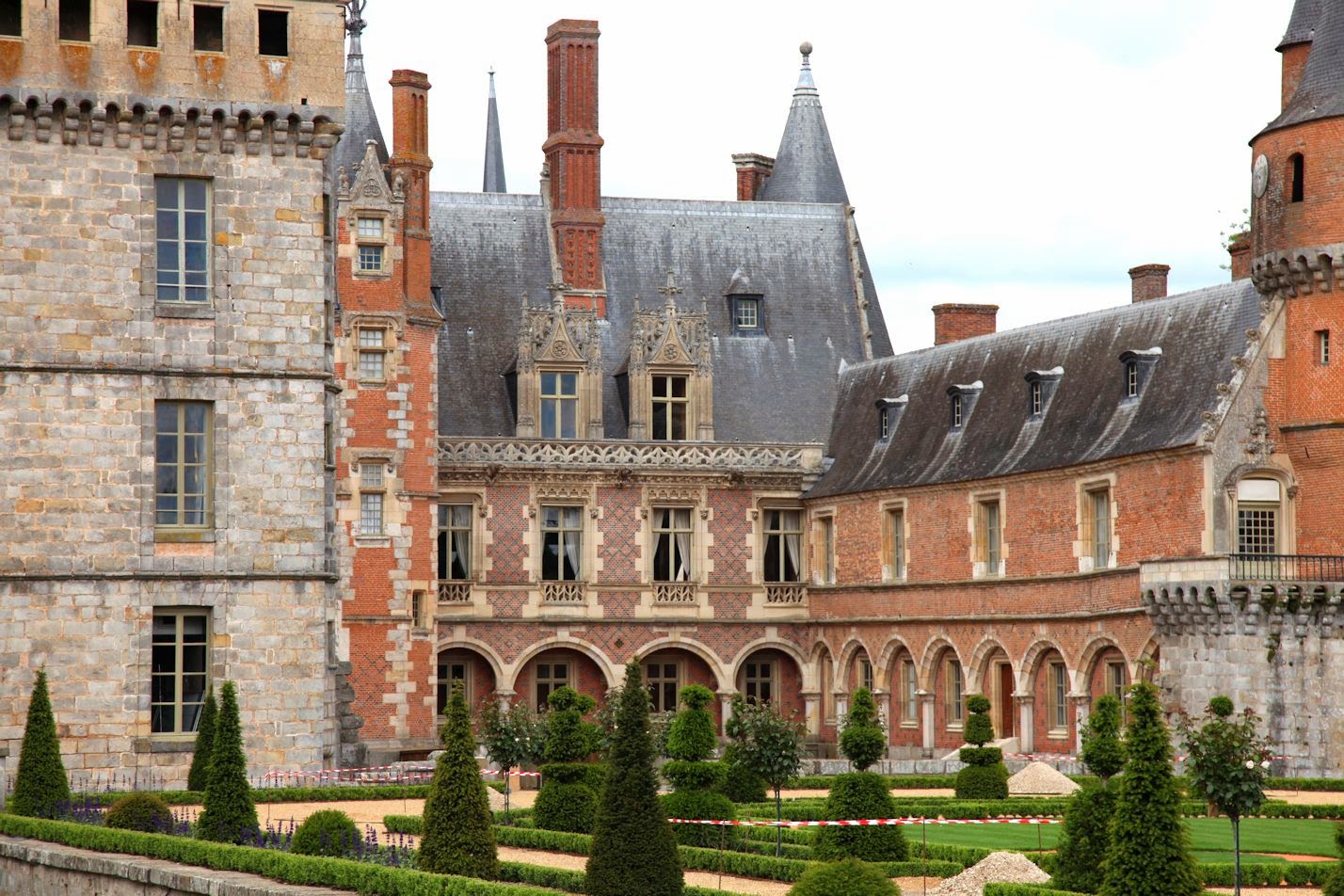
Less than 90km southwest of Paris, or just 20 minutes from Chartres, is a village called Maintenon, made famous by its eponymous chateau.
This belongs to the larger region of the Loire, or more specifically Loir-et-Eure, well known for its agricultural products, most notably wheat. A whole route of the region (La Route du Blé) is drawn across wheat fields, much like wine-producing regions. Without a doubt, the bake goods in this region are fantastic.
La Route du Blé passes through many distinct and less-visited towns, including Maintenon. Two important attractions here: the chateau and the aqueduct.
First built in the early 12th century, it passed through the hands of the Lords of Maintenon to the Finance Treasurer of Charles VIII to François d’Aubigné, second wife to Louis XIV.
It was François d'Aubigné, later known as Madame Maintenon, who transformed the former medieval castle into the great manor house we see today. Photographs are not allowed to be taken inside the apartments, and some of the rooms aren't as "touched up" as those in the Versailles. Still, they afford glimpses into the luxuriousness of the chateau and they take you back to the glorious days of French Renaissance. An impressive art collection and furniture are outfitted by the present owner, the Raindres.
Perhaps as impressive as the chateau is the garden. A vast expanse of green and 'tree-tunnels' spell out this French-style garden, as well as a structure that your eyes cannot miss: the aqueduct. At the construction of the Versailles, some 60km away, there was a shortage of water for 1400 water fountains and lakes that are required to be running and flowing. Water has to be brought in, and the water of the Loir was preferred by Louis XIV. An aqueduct was proposed and construction began. Parts of it passed through the Chateau de Maintenon, whose glory remains now adorns the garden. The aqueduct was never finished, and the project was abandoned by 1695. A lack of funding, perhaps; or did King Louis come to his senses that powering 1400 active water spectacle in his backyard is just ridiculous?
Official site: http://www.chateaudemaintenon.fr/
Also reachable by train from Chartres Station in just 22 minutes.
There are certainly no shortage of eateries in Perpignan, the second most important city of Catalonia (see my previous post on Perpignan). Tapas bars and restaurants are everywhere to be seen, and chefs from every generation cook up a unique blend of French-Catalan cuisine.
Every dish begins with the ingredients, and the Pyrénées offers a bounty of great and fresh produce. Scout around the busy market for local flavours as well as an eclectic (or even exotic) mix of ingredients, from salted bacalao to dried chilli peppers.
I was led to the legendary restaurant Casa Sansa for lunch, which was half hidden in a narrow lane, steps from the castle tower in the historic old town. Here is an interpretation of French-Catalan dishes at its finest: fresh, full of flavours, earthy and organic, made all the more interesting with subtle addition of herbs and spices. Nothing is overpowering the freshness of the ingredients and the simplicity of its presentation.
Very much like Barcelona or Girona, locals sit out in cafés and wine bars wherever there is empty street space. Catalan flags fluttering in the wind, view of the castle tower, canal and plazas all make up such a pretty sight that even a painter couldn't have captured it better.
Discover the colourful cuisine of the region here: http://en.perpignan-mediterranee-tourisme.fr/home/gastronomy/cuisinecatalane.aspx
So is this French-Catalan or Catalan-French?