Ernest So is a concert pianist who appears regularly in recitals across Europe, Asia, the US, Australia, and the Middle East. He is a lover of history, an avid traveler, collector, gastronome, and an all-round bon vivant. With an aching knack for the obscure, he actively seeks out unique travel experiences, which he will share with you in this blog.
Showing posts with label Italy. Show all posts
Thursday, 24 July 2014
Burrowing through Mont Blanc
Mont Blanc (or 'White Mountain') is the natural mountain that acts as a border between France and Italy. A tunnel was built in 1957 to facilitate traffic between both sides, and this Mont Blanc Tunnel is one of the longest car tunnels in the world, measuring over 11km.
This is also one of the few points within Europe/Schengen States that you will get a chop in the passport at the border checkpoint. There is a small parking site on either side for you to pause and enjoy the breathtaking scenery.
Exiting on the Italian side, the panoramic view of the deep valley gorge will find no rest for your eyes. If you enjoy driving this is one of the routes in Europe that you cannot miss.
The first big town would be Aosta. Stop by for sumptuous local fares that combine French and Swiss influences with Italy flair such as richly flavoured soups and risottos.
Here is more information about the tunnel, including the toll charge: http://www.chamonix.net/english/travel/mont-blanc-tunnel
Location:
Mont Blanc, 74400 Chamonix, France
Tuesday, 8 July 2014
Follina and its historic Abbey on the Prosecco route
The whole Veneto region in northern Italy is peppered with historical monuments of every epoch. Set right in the middle of the Prosecco route, an hour north of Venice, is a small village called Follina. Not only is this a quaint little pit-stop for travellers to rest between Prosecco tastings - there aren't any vineyards here, but the restaurants are particularly noteworthy - it boosts a treasured Italian National Monument, the Follina Abbey.
The town is set on a plain immediately in front of a huge mountain and there stood a monastic complex dating back to 12th century. Very much in the look and feel of a Cistercian monastery (as in those most often seen in France and Northern Spain), with a cloister, stone pillars, wooden and tiled roof, a beautiful church constructed around the same period, all rich in metaphors and Christian symbolisms. The Italian Inquisition of 1542 in these northern provinces no doubt put the future of the monastery in jeopardy, and its importance declined from then on until it was resettled by the Servite Order (or Servants of Mary) exactly 100 years ago, when it was finally declared a national monument by the Italian government.
This certainly is worth a stopover when you are in the region, perhaps even to stay a night in order to enjoy the restaurants. Here is a wonderful guide written for (or by) students that you should bring along when visiting the Abbey: http://www.tronweb.it/sulle_tracce_dei_monaci/follina/descrizione_inglese
The Hotel Villa Abbazia is diagonally across the Abbey and offers limited terrace seating in its restaurant with a stunning view of the Abbey and the mountains.
Location:
31051 Follina Treviso, Italy
Sunday, 29 June 2014
A bird's eye view on Tuscany from the Etruscan village of Artimino
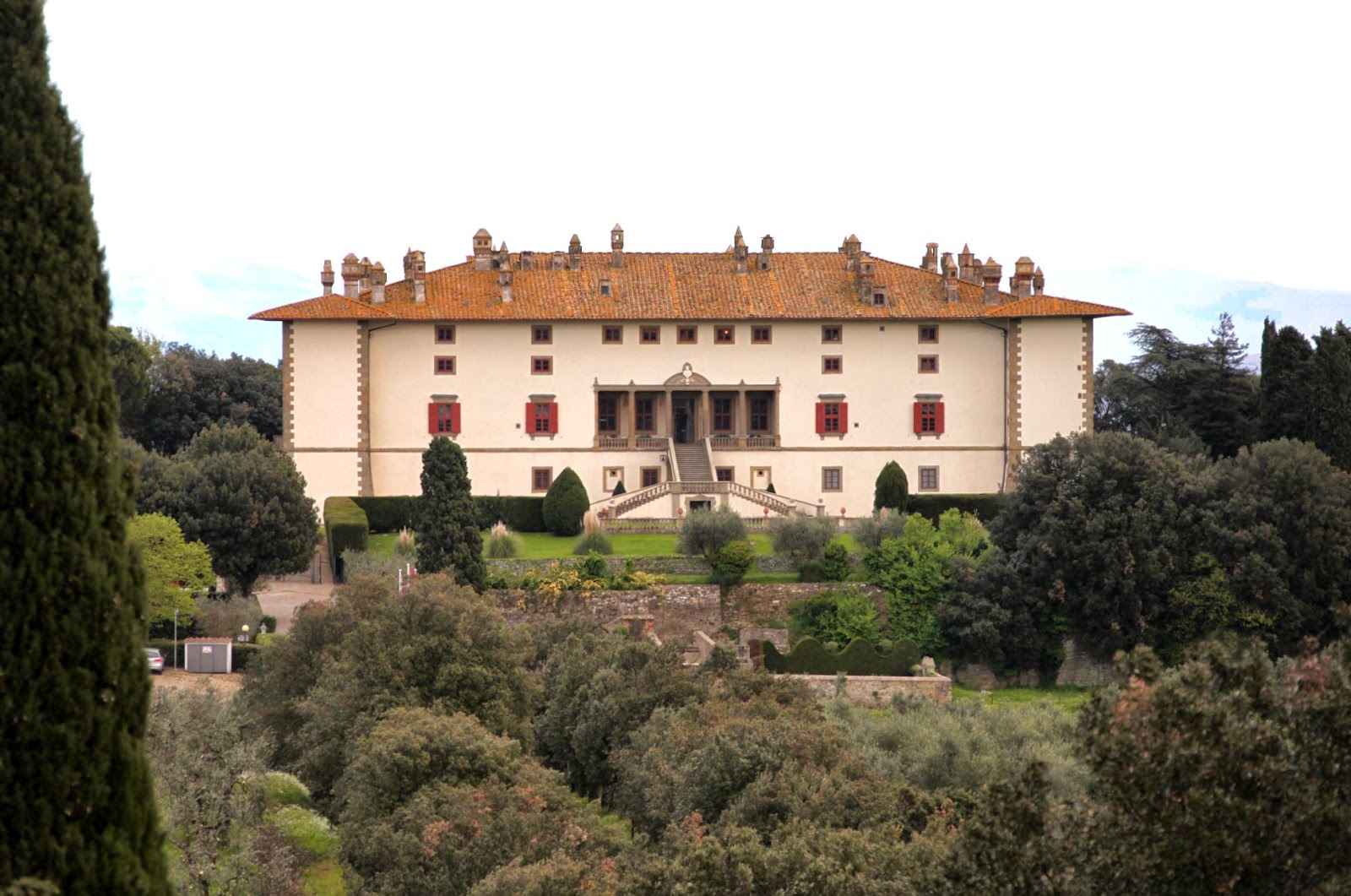
Heading out in search of one of the less visited Medici villa, La Ferdinanda, which occupied an even older castle, we stumbled upon a small village so rich in history that makes this 11th century castle villa seems like a new property.
Merely 40 minutes west of Florence, passing through a small town called Montelupo that specializes in ceramic making with factories open for visits, up a hill called Montalbano, sits the Etruscan village Artimino. Little information can be found on the internet (no Wikipedia entry and only a short blurb on Michelin guide), this seems like one of those villages George Clooney filmed "The American" - a perfect hideout for a contract killer.
A walled medieval village, the entrance is an opening underneath the crenellated clock tower. The layout of the village, which isn't complicated at all, is said to have remained unchanged for hundreds of years: a one-way circular route no more than 600 meter in its circumference with two inner paths.
Occupied by the Florentines since 1327, most of its land was purchased by the Medici, and by 1596 the villa across from the village began construction. They must have seen what we saw that day: an unobstructed view over the Tuscan landscape.
| Medici Villa, La Ferdinanda |
The 1000-year-old church of San Leonardo is set outside the walled village, as is a common practice at that time: the separation of the castle and the church signifies the disparity in their domain of power over the people.
The Ferdinanda and the Artimino are now classified as UNESCO Heritage Sites: http://www.artimino.com/
Location:
59015 Artimino Prato, Italy
Subscribe to:
Posts (Atom)